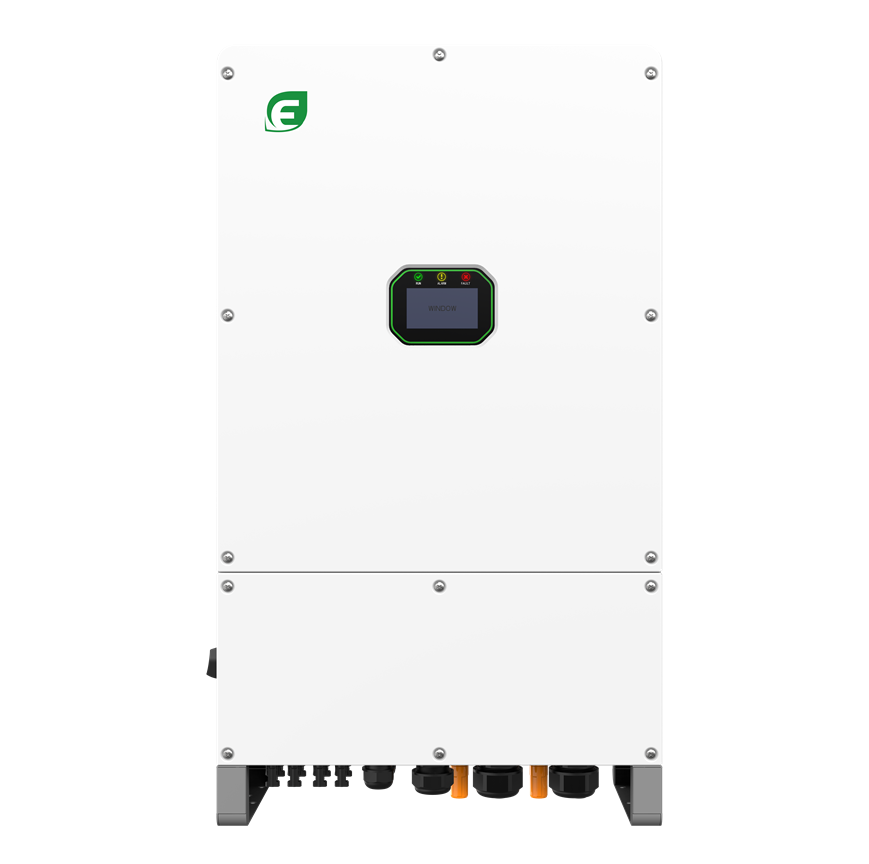
Small manufacturing plants and workshops often face a combination of high daytime electricity demand, limited rooftop space, variable production schedules, and the need for reliable backup power. Adding solar and battery storage can help these facilities use on-site generation more effectively while managing demand during expensive periods. A properly sized commercial hybrid inverter becomes the control point connecting PV, batteries, the utility grid, and critical loads, making its architecture important to both project economics and operational reliability.
Why Hybrid Inverters Suit Small Industrial Facilities
Manufacturing facilities rarely have perfectly predictable electricity consumption. Motors, compressors, welding equipment, machine tools, HVAC systems, and other loads can create substantial variations throughout the working day. Solar generation follows a different pattern, typically reaching its highest output around midday rather than necessarily matching the facility’s highest demand.
Battery storage can bridge this mismatch by storing surplus solar energy and releasing it when demand increases. The U.S. Department of Energy notes that storage can help shift solar energy to periods when demand is higher or solar production has declined.
A hybrid inverter combines several functions within the same power-conversion architecture. Instead of treating PV generation, battery storage, and backup power as completely separate systems, it can coordinate their operation according to predefined energy priorities.
What a 40–60 kW System Can Provide
The 40–60 kW range can be relevant to smaller factories and workshops where electrical demand is substantial but does not justify a much larger single conversion platform. Enjoypowers’ 40/50/60 kW hybrid inverter family is designed around three power ratings within an IP66 outdoor enclosure.
The manufacturer identifies applications including commercial rooftops, off-grid sites, and small commercial or midsized factories. Its product-family information also describes integrated PV, battery, and grid functions, together with VSG grid-forming control and less than 10 ms grid-to-backup transfer for critical loads.
This type of integration can simplify system architecture when space, installation time, and equipment coordination are important considerations for an industrial site.
PV Capacity and Battery Integration Matter
Selecting a commercial hybrid solar inverter requires more than matching inverter output power to the facility’s average load. Engineers should consider the planned PV capacity, battery size, load profile, utility connection, and expected operating modes.
The Enjoypowers 40/50/60 kW platform is specified with PV input capacity of up to 120 kWp and maximum efficiency of 98%. Its three-level topology is designed around optimized switching frequencies, with the manufacturer stating that efficiency remains stable across the 30%–100% load range.
For a workshop with substantial daytime consumption, a larger PV array can provide more energy for direct self-consumption while leaving battery capacity available for later use. The final PV-to-inverter ratio should still be established according to local solar conditions, system design requirements, and equipment limits.
Five Operating Modes for Commercial Energy Management
The value of a hybrid inverter extends beyond converting DC electricity into AC power. Energy management determines when the system should use solar generation, charge the battery, draw from the grid, or discharge stored energy.
Enjoypowers specifies five operating approaches for its commercial hybrid solar inverter platform: self-consumption, peak shaving, time-of-use arbitrage, grid-tied/off-grid/hybrid operation, and genset support. Its EMS coordinates PV, battery, grid, and generator priorities automatically.
These functions can be particularly useful for facilities operating under time-of-use electricity tariffs. During lower-cost periods, the battery can be charged according to the configured strategy. During expensive periods or demand peaks, stored energy can be discharged to reduce grid consumption.
The U.S. Department of Energy’s energy-storage evaluation tools likewise recognize peak shaving and time-of-use tariff structures as relevant commercial battery applications.
Peak Shaving for Manufacturing Loads
Peak demand can be an important consideration for commercial and industrial electricity users. A workshop may consume moderate energy for much of the day but experience short periods of significantly higher demand when several machines operate simultaneously.
Battery storage can respond to these peaks without requiring the facility to obtain all of its instantaneous power from the grid. The control strategy must, however, account for the duration and magnitude of the peak, battery state of charge, inverter capacity, and the facility’s load profile.
A hybrid inverter with integrated EMS can coordinate these variables. For commercial PV projects, Enjoypowers specifically identifies time-of-use arbitrage combined with peak-demand reduction as a typical configuration.
Why IP66 Protection Is Relevant Outdoors
Industrial rooftop and outdoor installations can expose power electronics to dust, rain, moisture, and other environmental conditions. Enclosure protection therefore becomes an important consideration when equipment is installed outside a dedicated electrical room.
Enjoypowers specifies an IP66 enclosure for its 40/50/60 kW hybrid inverter platform. The company’s product-family information describes the units as suitable for direct outdoor installation.
For project engineers, IP protection should still be evaluated together with ambient-temperature limits, ventilation, solar exposure, installation clearance, corrosion conditions, and maintenance access. An enclosure rating does not eliminate the need for appropriate site engineering.
Backup Power and Off-Grid Capability
Power continuity can be especially important for workshops where an unexpected outage could interrupt production, damage work-in-process, or require equipment to be restarted manually. A hybrid system can reserve battery capacity for critical loads instead of using all available storage for energy-cost optimization.
The Enjoypowers platform integrates on-grid and off-grid AC output and includes VSG grid-forming control. Its published product-family information specifies a grid-to-backup transfer time of less than 10 ms for critical loads.
For a manufacturing project, engineers should define which loads are critical before commissioning. Motors and other large loads may also require specific consideration because their startup characteristics can influence inverter sizing.
Evaluating the Total System Rather Than the Inverter Alone
A successful commercial hybrid project depends on more than inverter efficiency or rated power. PV array sizing, battery capacity, tariff structure, load behavior, backup requirements, EMS functionality, and local grid requirements all influence the system’s performance.
Enjoypowers’ broader C&I energy-storage portfolio identifies peak shaving, demand-charge reduction, and backup power as applications for factories and commercial buildings. The company states that its C&I solutions are sized from 100 kW to 5 MW at the site level, while its 40/50/60 kW hybrid inverter platform can address smaller commercial and industrial applications.
For smaller facilities, selecting a platform that combines PV, battery management, grid interaction, and backup functions can reduce system complexity.
Building a Practical Energy Strategy for Small Facilities
A 40–60 kW hybrid inverter can provide a practical foundation for small manufacturing plants and workshops seeking to integrate solar generation with battery storage. The most important selection criteria extend beyond nominal output: PV input capability, efficiency across the expected load range, environmental protection, operating modes, backup performance, and EMS coordination all deserve consideration.
Enjoypowers‘ 40/50/60 kW IP66 platform combines up to 120 kWp PV input, 98% maximum efficiency, five commercial operating modes, and integrated PV-battery-grid functionality. For business project teams, these specifications provide a starting point for evaluating whether the architecture matches a facility’s electrical profile.
The right commercial hybrid inverter is ultimately one that aligns conversion capacity with actual production demand while supporting the site’s financial, resilience, and renewable-energy objectives.
