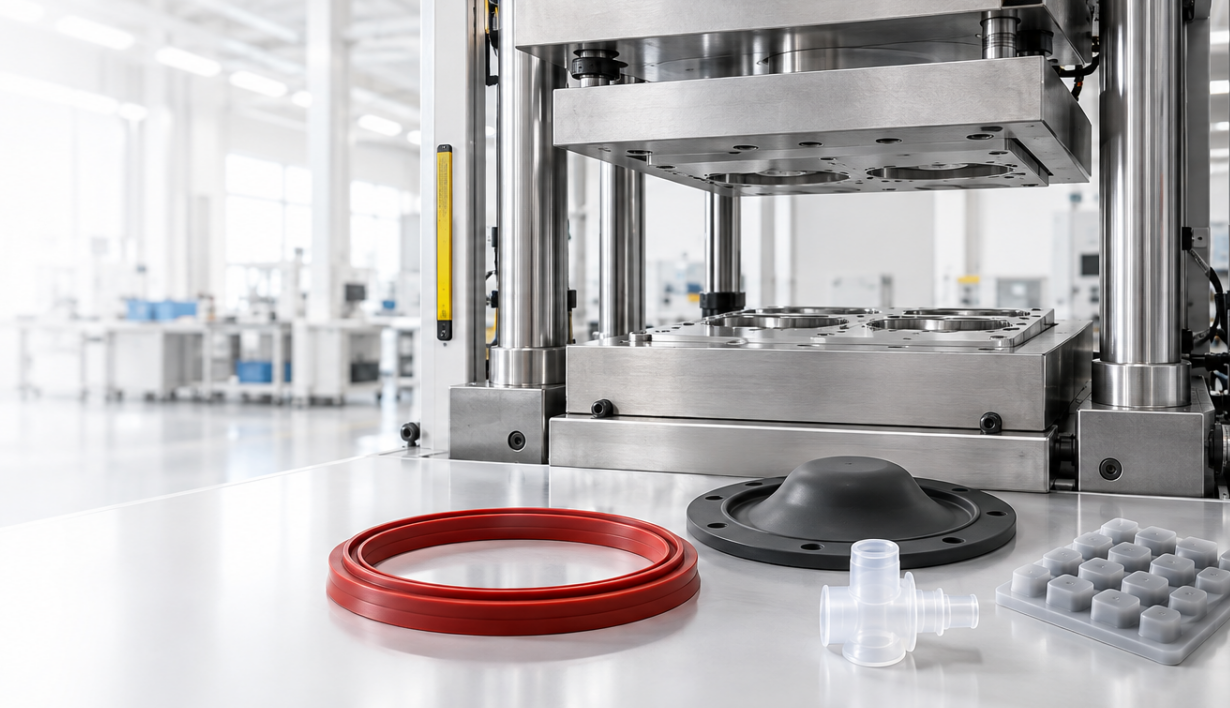
Heavy-duty structural applications often demand material properties that standard thermoplastic injection techniques fail to deliver under extreme mechanical loads. Industrial designers working with high-performance thermosets or long-fiber composites must evaluate alternative manufacturing methods capable of handling viscous, high-molecular-weight polymers.
Compression molding provides a reliable route for shaping heavy-duty components that require exceptional dimensional stability and structural integrity. Selecting this specific fabrication process depends on understanding how raw material charges behave under intense hydraulic clamping force and elevated thermal conditions.
Mechanics of Pre-Formed Charge Placement and Cavity Consolidation
Raw material preparation differs fundamentally from conventional pellet injection because operators place a pre-measured polymer charge directly into an open mold cavity.
Gravity and precise volumetric sizing dictate how the material sits before upper and lower tool halves close together. HordRT engineers calculate exact charge weights to eliminate excess flash while ensuring complete cavity fill without voids.
Hydraulic presses then apply vertical downward pressure, forcing the viscous compound to flow outward and fill complex internal contours uniformly. Maintaining strict mass accuracy during raw charge preparation prevents structural inconsistencies across finished batches.
Controlled closing speeds prevent premature cross-linking or fiber damage during the initial compaction phase of active production cycles. Operators monitor pressure ramp-up rates closely to guarantee that trapped air escapes through dedicated parting line vents before final consolidation occurs.
Achieving uniform density across thick-walled geometry requires precise synchronization between platen movement and material flow characteristics. Master toolmakers design specialized shear edges that cleanly shear off excess material as the mold reaches its fully closed position. Proper venting geometry eliminates surface blemishes and internal voids efficiently.
Retaining Fiber Length and Structural Integrity in Thermosets
Glass or carbon fiber reinforcement additives provide extraordinary stiffness and tensile strength for demanding aerospace and automotive structural components. Traditional screw-based injection systems frequently shear these reinforcement fibers down into shorter lengths, severely degrading their mechanical contribution. Compression molding avoids screw shear entirely because the raw charge is placed statically into the open tool before mechanical pressure is applied.
Preserving long fiber architectures ensures that load paths remain continuous throughout the entire finished structural part. Maintaining fiber integrity maximizes impact resistance and structural fatigue limits under heavy operational loads.
Reactive polymer systems such as epoxies, phenolics, and bulk molding compounds undergo irreversible chemical reactions under sustained heat and pressure. Molecular cross-linking creates a rigid three-dimensional network that resists creep, chemical degradation, and high operational temperatures effectively. Technical teams must account for chemical shrinkage rates during initial mold design to satisfy strict dimensional tolerances on finished parts.
Proper handling of these reactive raw systems requires strict temperature zoning across upper and lower heating platens. Controlling thermal gradients prevents warping and ensures uniform molecular density distribution.
Thermal Pressing Cycles and Cross-Linking Dynamics
Heating elements embedded within steel tool blocks transfer thermal energy directly into the resin charge to initiate rapid polymerization. Temperature control units maintain steady surface conditions to ensure that the entire mass cures evenly without localized hot spots or under-cured zones.
HordRT utilizes advanced thermal monitoring sensors to track cure progression in real time, minimizing cycle times while guaranteeing full material conversion. Rapid curing cycles maximize throughput for high-volume industrial manufacturing programs requiring consistent mechanical performance across every production batch. Precise thermal management secures optimal cross-linking density throughout complex geometries.
Opening the press requires careful extraction mechanics because fully cured thermoset components lack the elastic flexibility of cooling thermoplastics. Ejector pin layouts must distribute stripping forces evenly across rigid part surfaces to prevent distortion or cracking upon demolding.
Tooling designers incorporate generous draft angles and specialized release coatings into internal cavity walls to facilitate smooth part removal. Managing thermal expansion differentials between the hot steel mold and the cured polymer prevents sticking issues during high-frequency production runs. Proper part ejection protocols protect delicate surface finishes and extend active tool lifespans.
Evaluating Tooling Pressures and Component Load Capacity
Massive hydraulic clamping forces are mandatory to counteract the high internal pressures generated during the final stages of cavity consolidation. Engineers calculate required tonnage ratings based on projected part surface area and material viscosity to prevent parting line separation. Compression molding tools require robust structural steel construction to withstand millions of high-tonnage cycles without deflection or structural fatigue.
Choosing appropriate tool steels like H13 or P20 ensures long-term durability when processing abrasive filled compounds. Maintaining rigorous clamping stability prevents flash generation and dimensional drift over long production runs.
Final component performance depends heavily on post-curing quality evaluations, including non-destructive testing and mechanical stress verification under load. HordRT provides comprehensive dimensional inspection services to verify that finished hardware complies with strict aerospace and automotive regulatory standards.
Partnering with experienced manufacturers guarantees that complex composite parts achieve maximum structural reliability without unexpected mid-lifecycle failures. Careful process optimization transforms challenging thermoset formulations into robust industrial components built to withstand punishing operating environments. Rigorous metrology reporting ensures absolute quality compliance before customer shipment.
Achieving Reliable Heavy-Duty Composite Manufacturing
Mastering heavy-duty composite manufacturing requires deep technical insight into material rheology, thermal management, and hydraulic pressure control. Selecting appropriate production routes empowers engineering organizations to build high-strength hardware that outlasts conventional plastic alternatives under stress.
Delivering expert manufacturing support, specialized teams guide projects from initial material selection straight through to final high-tonnage production runs. Engineering teams seeking absolute structural reliability benefit immensely from partnering with experienced specialists dedicated to advanced composite fabrication. Securing long-term operational success depends on continuous process refinement and uncompromising quality standards.
