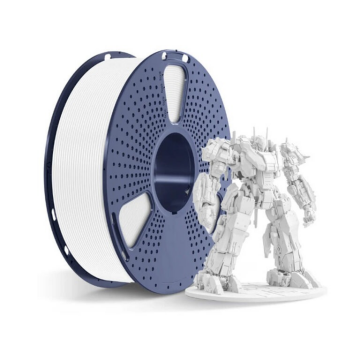
Standard PLA suits many everyday prints, while PLA+ targets users seeking added toughness. PLA+ 2.0 adds claims about toughness relative to standard PLA+ and features related to filament handling.
For anyone comparing 3d printer pla filament, the key question is which differences matter for their projects. A newer version is not automatically worth the extra expense.
SUNLU describes PLA+ 2.0 as offering two to three times the toughness of standard PLA and also highlights “smoother extrusion” and “Neat filament winding.” These are claims about material behavior and handling, so they should be considered separately from the mechanical measurements in the specification table.
What Changes Between the Three Filaments?
Standard PLA is described as easy to print with low warping. PLA+ is positioned as reinforced and toughened, with improved impact resistance. PLA+ 2.0 focuses on toughness alongside features intended to support extrusion and filament feeding.
These products emphasize different priorities. Print appearance depends on settings and design, while durability is also influenced by geometry, layer orientation, wall thickness, and the force applied to the finished part.
What Do the Published Mechanical Properties Show?
| Property | Standard PLA | PLA+ | PLA+ 2.0 |
| Tensile strength | 40 ± 6 MPa | 46 ± 5 MPa | 46 ± 5 MPa |
| Flexural strength | 65 ± 6 MPa | 83 ± 5 MPa | 83 ± 5 MPa |
| Notched Izod impact strength | 5 ± 3 kJ/m² | 10 ± 3 kJ/m² | 10 ± 3 kJ/m² |
| Elongation at break | 10 ± 5% | 10 ± 2.5% | 10 ± 2.5% |
Tensile strength describes resistance to pulling forces, while flexural strength relates to bending. Notched impact strength measures a sample’s response to sudden impact, and elongation at break indicates how far it stretches before fracturing. Each test describes a different property.
The table shows measurable differences between standard PLA and the two upgraded formulations. PLA+ and PLA+ 2.0 share the same reported values across these four properties, so the published data do not show a higher rating for PLA+ 2.0 in these categories.
The units also differ: MPa expresses stress, while kJ/m² describes impact strength. Compare values within each property, not across unlike rows. Elongation is a percentage describing deformation before fracture, not load capacity on its own.
When Does Standard PLA Fit the Job?
Standard PLA remains a practical option for decorative models, display objects, and prototypes that experience limited mechanical stress. Its ease of printing and low-warping profile can be attractive when existing results meet the project’s needs.
If a part is rarely handled and performs as intended, paying more for a tougher formulation may bring limited benefit. Layer height, print orientation, wall count, and supports can also influence the finished result.
What Does PLA+ Add?
PLA+ is aimed at users seeking a tougher alternative to standard PLA. It may suit holders, housings, accessories, and models that receive regular handling. The value comes from matching the material’s intended properties to the demands placed on the printed part.
Thin tabs, sharp internal corners, or layers aligned across the direction of force can remain vulnerable. Part design and print setup influence how a finished object responds to use.
What Makes PLA+ 2.0 Different?
SUNLU’s PLA+ 2.0 listing specifies a 1.75 mm filament diameter with a ±0.02 mm tolerance. It also highlights “smoother extrusion” and “Neat filament winding,” with winding intended to reduce tangling and feeding-related clogs. These features may be relevant to users who change spools frequently or run longer prints.
A search for 3d printer filament pla plus often reflects a practical question: do the handling claims or mechanical ratings justify the higher price? Separate those claims when comparing options. PLA+ 2.0 lists the same tensile, flexural, impact, and elongation values as PLA+.
Its product positioning focuses on the stated toughness comparison with standard PLA+ and the additional filament-handling features, not higher values in these four categories.
When Is the Upgrade Worth the Cost?
PLA+ may justify a higher price when added toughness addresses a recurring limitation with standard PLA. PLA+ 2.0 may appeal to buyers who also value its stated winding and extrusion features. The value depends on spool price, use frequency, feeding behavior, and the type of parts being printed.
For projects with modest toughness demands, an upgrade may add cost without a noticeable benefit. Users who experience material breakage or feeding interruptions have a clearer reason to compare the upgraded options. Product version numbers alone say little about a specific print’s results.
How Should You Make the Choice?
Start with the performance the project calls for. Standard PLA covers many general-printing needs; PLA+ offers a toughness-focused alternative; PLA+ 2.0 adds stated benefits around toughness relative to standard PLA+ and filament handling.
The product descriptions help distinguish these positions, while the table shows where the numerical properties overlap.
The right purchase is the one that addresses a real need at a cost that fits the workflow. When current filament produces suitable results, keeping it can be a reasonable decision. When durability or feeding consistency is a recurring concern, the upgraded formulations merit closer comparison.
