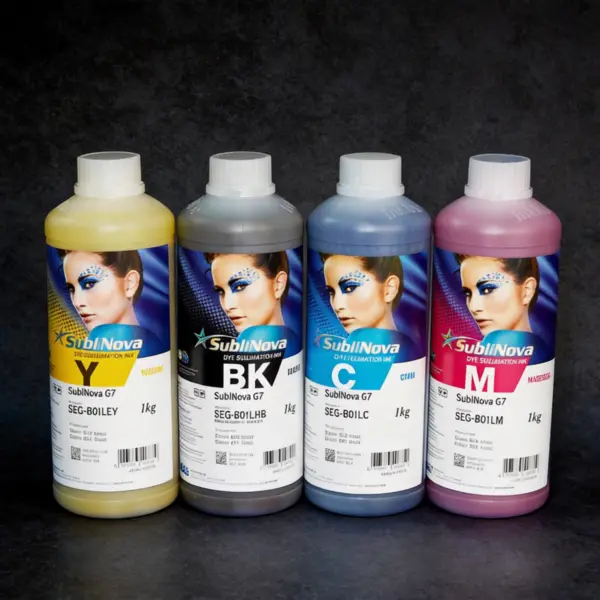
Evaluating operational expenses in digital decoration requires print facility managers to assess fluid formulation stability alongside consumable acquisition models. Selecting high-grade sublimation ink allows commercial enterprises to maintain consistent image resolution across ceramic, metal, and polyester substrates.
Disperse dyes suspended in aqueous liquid carriers transition directly from solid to gaseous states when exposed to intense heat and mechanical pressure. Bypassing the liquid phase during thermal transfer enables gaseous particles to penetrate open synthetic polymers without altering the underlying surface texture.
Sublimation Phase Change Mechanics
Thermal activation occurring between 180°C and 210°C triggers the phase conversion characteristic of specialized disperse dye formulations. Vaporized dye molecules bond directly within heated polymer chains, sealing colors deep inside the material as temperature levels drop.
Because graphics fuse internally rather than adhering to surface layers, finished prints resist cracking, peeling, and washing degradation over continuous commercial use. This molecular integration makes thermal dye transfer suitable for activewear, custom phone cases, and outdoor soft signage.
Chemical Compatibility and Substrate Surface Bonding
Formulating digital dyes requires balancing fluid viscosity, particle size, and surface tension to suit piezoelectric printhead channels. Utilizing stable sublimation ink prevents jet deflection, keeping micro-droplet trajectories accurate during high-speed production runs.
Non-porous items like coated ceramic mugs or aluminum panels require specialized polymer pre-coatings to capture vaporized dye. When thermal presses apply heat, gaseous colorants bind securely into the polymer layer, creating bright, scratch-resistant finished items.
Cost Efficiency and Consumable Logistics
Sourcing high-volume consumables directly impacts profit margins for commercial print shops handling large contract volumes. Securing sublimation ink bulk packages reduces per-liter fluid expenses while decreasing packaging waste across daily factory shifts.
Large fluid containers streamline continuous supply systems, maintaining steady head pressure in secondary ink reservoirs. Facility managers purchasing sublimation ink bulk quantities establish predictable operating budgets for seasonal apparel runs.
Fluid Density and Nozzle Clogging Prevention
Disperse dye particles must undergo rigorous micro-milling during chemical production to prevent pigment agglomeration within delicate printhead channels. Formulations supplied by Xinflying maintain uniform particle distribution, safeguarding piezo elements against blockages during extended idle periods.
Controlled fluid viscosity prevents micro-jet deflection during fast carriage movements across continuous roll media. Clean fluid dynamics reduce manual wiping requirements, extending overall printhead operational lifespan in busy workshops.
Commercial Scale Application Across Diverse Products
Custom sportswear, promotional apparel, and corporate accessories rely on digital heat transfer to produce vibrant graphics without individual screen setups. Commercial dye formulations deposit high-density CMYK colors that yield rich blacks and smooth color transitions across complex artwork.
Decentralized product portfolios benefit from short setup times and flexible batch sizes made possible by digital transfer technology. Adapting print files electronically allows shops to switch from t-shirts to hard surface ceramics without changing ink lines.
Color Gamut Precision and Batch Uniformity
Maintaining strict chromatic standards between fluid manufacturing lots protects commercial print shops from unintended color variation. Purchasing through trusted suppliers like Xinflying helps print providers deliver uniform color accuracy across multi-part production contracts.
Precise pigment concentration allows raster image processor (RIP) software to calculate accurate ink limit profiles before printing starts. Consistent dye behavior prevents over-saturation on lightweight transfer paper while maintaining visual contrast.
Packaging Formats and Supply Storage Practices
Commercial fluid packaging options range from 1-liter bottles to 20-liter bulk containers tailored for high-output manufacturing setups. Adopting sublimation ink bulk storage protocols helps print shops maintain adequate material reserves for unexpected order spikes.
Storing fluid containers in temperature-controlled spaces away from direct sunlight prevents chemical separation and viscosity shifts. Shaking bulk containers gently before filling primary reservoirs maintains even pigment suspension across all channels.
Environmental Profiles and Workplace Safety
Water-based disperse dye formulations reduce volatile organic compound emissions compared to solvent-based alternatives. Omitting toxic chemical additives protects indoor air quality in busy printing rooms and lowers environmental compliance burdens. By sidestepping the regulatory burdens associated with hazardous air pollutants (HAPs) and ozone-depleting solvents, facilities can maintain simpler permitting pathways and avoid the administrative overhead of rigorous emissions reporting.
Eco-friendly fluid profiles simplify wastewater disposal practices while supporting sustainable manufacturing standards. Cleaner chemical chemistry creates safer working environments for equipment technicians and print operators. Operators who feel confident that the chemicals they handle daily pose minimal health risks are more engaged and retain longer in production roles, reducing recruitment and training costs in a competitive labor market.
Operational Reliability in High-Volume Workflows
Integrating stabilized fluid lines minimizes unexpected downtime caused by nozzle drying during short operational pauses. Equipment solutions backed by Xinflying provide reliable fluid transport channels that maintain uniform color delivery during multi-shift operations.
Streamlined procurement strategies ensure continuous factory throughput without material shortages. Dependable dye performance reduces paper scrap and fabric rework caused by color shifting or nozzle dropouts.
Maximize Your Production Value with Reliable Ink Solutions
The quality of sublimation ink directly influences output consistency, production costs, and hardware longevity in commercial printing operations. Stable dye formulations reduce waste, protect printhead investments, and ensure color uniformity across diverse substrates and order volumes.
For production managers seeking to optimize consumable procurement and streamline ink supply chains, Xinflying offers reliable bulk ink solutions backed by consistent formulation quality and responsive technical support. Contact the Xinflying team to discuss your fluid requirements and explore how professional ink management can improve your bottom line.
