Chronic total occlusion (CTO) PCI is rarely a one-wire exercise. As a guidewire encounters different levels of resistance within an occlusion, the procedural strategy may need to adapt to lesion characteristics, wire behavior, and the position of the wire relative to the vessel architecture. For hospitals, distributors, and medical-device procurement teams, this makes guidewire selection more than a matter of choosing the highest penetration capability available.
A useful procurement approach starts by understanding how resistance affects wire selection and escalation. A PTCA guide wire should be evaluated according to its intended role, tip characteristics, support, steerability, coating, and compatibility with the wider CTO workflow. Contemporary CTO literature describes wire escalation and de-escalation as strategies that adjust guidewire properties according to anatomy and progress during lesion crossing.
Why Resistance Matters in CTO Guide Wire Selection
Resistance within a CTO can arise from differences in lesion composition, length, calcification, tortuosity, and proximal or distal cap morphology. A wire that progresses effectively through one segment may not be appropriate when the vessel course becomes ambiguous or the occlusion becomes more resistant.
Current CTO literature emphasizes that guidewire selection should be based on the characteristics of the occlusion. Lower-penetration, polymer-jacketed wires may be considered in lesions where navigation and vessel tracking are prioritized, while higher-penetration wires may be selected when greater lesion penetration capability is required.
For procurement teams, this means a CTO guidewire portfolio should offer different characteristics rather than treating penetration force as the only performance criterion. The objective is to provide clinicians with options that correspond to different anatomical and procedural situations.
What Design Characteristics Should Buyers Examine?
Guidewire construction directly influences how a wire responds when it encounters resistance. Important characteristics include tip load, tip stiffness, flexibility, shaping behavior, torque transmission, shaft support, trackability, coating, and radiopacity. Reviews of CTO guidewires identify these properties as important factors when assessing their behavior during lesion crossing.
Tip design deserves particular attention. A wire with a more penetrative tip can provide greater capability for resistant tissue, while a softer or polymer-jacketed design may be considered for navigating an uncertain vessel course. The appropriate choice depends on the anatomy rather than simply selecting the wire with the greatest available penetration capability.
The coating can also influence handling. Hydrophilic or polymer-based surfaces can reduce friction and support navigation, while different core and distal constructions influence steering and tactile response. Buyers should therefore request technical documentation describing these characteristics instead of relying on general descriptions such as “high penetration” or “superior crossing.”
How Should a CTO Guide Wire Strategy Change With Resistance?
A progressive approach can be important when resistance changes during CTO crossing. Contemporary reviews describe antegrade wire escalation as a stepwise process in which wire properties are adjusted according to the lesion. If a softer wire does not make sufficient progress, moving to a wire with greater penetration capability may be considered. After a resistant segment has been successfully negotiated, operators may consider de-escalating to a less penetrative wire when appropriate for the subsequent procedural strategy.
This approach is important from a device-sourcing perspective because a single guidewire cannot necessarily address every stage of a complex CTO. A supplier can support procurement planning by offering clearly differentiated guidewire configurations with different tip characteristics, lengths, and handling features, allowing buyers to build a product range around different procedural requirements.
Microcatheter compatibility is another consideration. CTO literature describes microcatheters as supporting guidewire manipulation, wire exchange, and tip reshaping during antegrade approaches. Buyers should confirm which catheter systems and wire configurations are supported by the manufacturer’s documentation.
What Should Buyers Ask a CTO Guide Wire Supplier?
When comparing CTO guide wire products, procurement teams must analyze comprehensive technical specification sheets rather than relying on promotional summaries. Essential evaluation metrics include wire diameter, effective length, tip load, distal configuration, core construction, and shaping characteristics. Evaluating radiopaque visibility, shaft support, torque response, and microcatheter compatibility allows buyers to verify actual clinical performance across challenging lesions.
Data-driven technical comparisons enable procurement teams and international distributors to prepare precise product documentation, regulatory filings, and customer training materials.
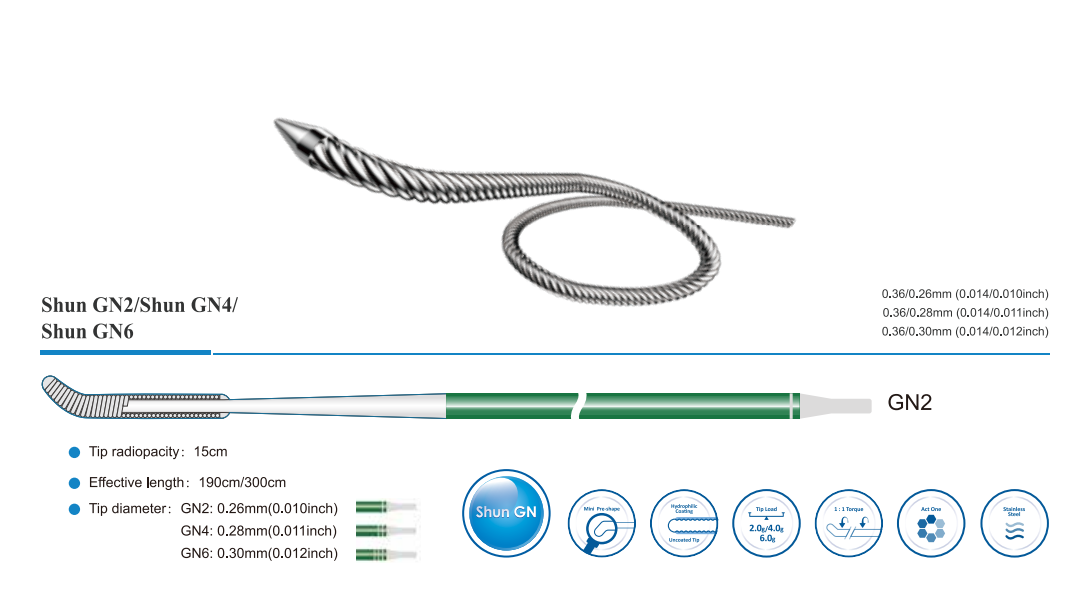
Shunmei positions its PTCA Guide Wire (CTO) within a broader coronary intervention portfolio alongside workhorse wires, hydrophilic guidewires, microcatheters, and balloon catheters. Its CTO guide wire range includes GN2/GN4/GN6 models with a 0.36 mm shaft diameter and 2.0/4.0/6.0 g tip loads, with effective lengths of 190 cm or 300 cm. These documented specifications provide concrete criteria for matching guide wire configurations to complex coronary intervention requirements.
Why Formal Technical Documentation Matters
A guidewire’s intended role should be clearly defined in its technical documentation. This is particularly important for CTO products because different wire characteristics can produce different handling behavior.
Manufacturers need to explain the design features supporting penetration, steering, support, and navigation without presenting those characteristics as guarantees of clinical success. Procurement teams also need to verify the current product specification, applicable regulatory documentation, labeling, packaging, and market-specific availability before placing an order.
For products such as Shunmei’s PTCA Guide Wire (CTO), the public product page provides model-level specifications, while procurement teams can request the latest technical documentation to confirm market-specific configurations, regulatory information, and ordering requirements. Procurement teams should therefore request the latest technical manual or specification sheet directly from the manufacturer when evaluating wire diameter, length, tip characteristics, coating, compatibility, and other purchasing parameters.
Building a Practical CTO Guide Wire Portfolio
When resistance changes during CTO crossing, the most useful product portfolio is one that gives professional users different wire characteristics for different procedural requirements. Procurement teams should therefore evaluate tip behavior, penetration capability, flexibility, torque response, coating, radiopacity, and microcatheter compatibility as a connected set of factors.
When reviewing Shunmei as a potential supplier, buyers can examine its CTO guidewire offering alongside its broader coronary intervention portfolio and request the latest product specifications, configurations, and regulatory documentation. This provides a more precise basis for evaluating whether the available guidewire options match the technical and procurement requirements of the target market.
