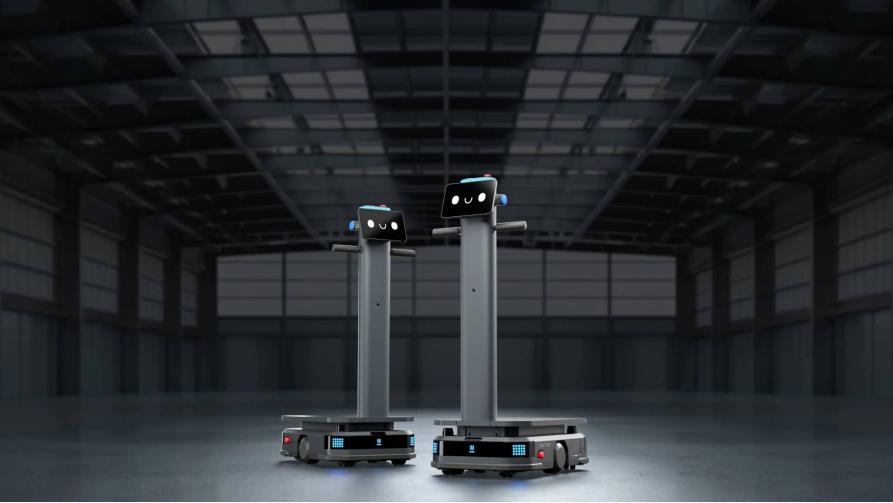
Why North American commercial-vehicle braking and ADAS suppliers are now treating template-driven AMR deployment as a labor-resilience play, with a Mexico plant deployment of 5 T300 robots as the operational reference.
May 26, 2026 | About 11 minutes read
Commercial-vehicle component plants do not look like passenger-vehicle final assembly. The lines are slower. The parts are heavier per item. The mix is more specialized: brake actuators, ABS modulators, air dryers, ADAS modules, electronic stability components. The customers are not consumers, they are truck OEMs and bus builders, and they tend to hold their suppliers to long-cycle quality and reliability standards that do not give a plant manager much room to experiment on the production floor.
That is the operational context for a recent deployment at a North American commercial-vehicle braking and ADAS leader’s Mexico plant, a tier-one supplier to truck and bus OEMs with a long-standing leadership position in the North American commercial-vehicle safety systems market. The plant brought five PUDU T300 industrial autonomous mobile robots online to handle the line-side delivery loop between a line-side warehouse and the processing material buffer area. The headline operational pattern is not the unit count or the deployment hours, although both were modest. It is two product capabilities that show up in a procurement decision long before the robots arrive on a forklift: preset task templates and multi-rack adaptation.
Both capabilities sound like footnotes on a spec sheet. In a real commercial-vehicle plant they decide whether the AMR fleet stays useful through a normal staffing month, or whether it becomes another shop-floor asset that needs a dedicated coordinator to keep running.
Why commercial-vehicle safety-systems plants are quietly automating line-side delivery
Two trends are pressing on commercial-vehicle component plants at the same time. First, the global commercial-vehicle market continues to add complexity. The International Energy Agency’s tracking through 2024 documents a heavy-duty vehicle sector adding more electronic safety content per truck (ABS, electronic stability control, ADAS sensor stacks), and the Motor and Equipment Manufacturers Association (MEMA) heavy-duty reporting shows commercial-vehicle suppliers absorbing both volume and product-mix expansion through the nearshoring cycle.
Second, the labor side is genuinely uneven. Commercial-vehicle plants in Mexico’s auto-parts corridor see operator headcount swing with normal turnover, holiday absences, regional events, and shift transitions. The line cannot stop, but the line-side delivery that feeds it can become a bottleneck when the shop is two or three operators short. The traditional response, asking experienced operators to double up on push-cart trips, costs more than it shows on paper: it pulls those operators away from inspection, assembly, and quality work that depends on their experience.
Buyers reading those signals often jump to a turnkey logistics-automation platform that promises to eliminate the labor exposure in one purchase. That is rarely how it plays out at a commercial-vehicle plant, because the customer-quality demands and the cycle-time discipline leave very little slack for a multi-month integration project. The deployment pattern in this case is the practical alternative: a small, template-driven fleet that handles a defined slice of the delivery workload reliably enough to be planned around.
The deployment pattern: 5 T300 robots, line-side warehouse to processing buffer
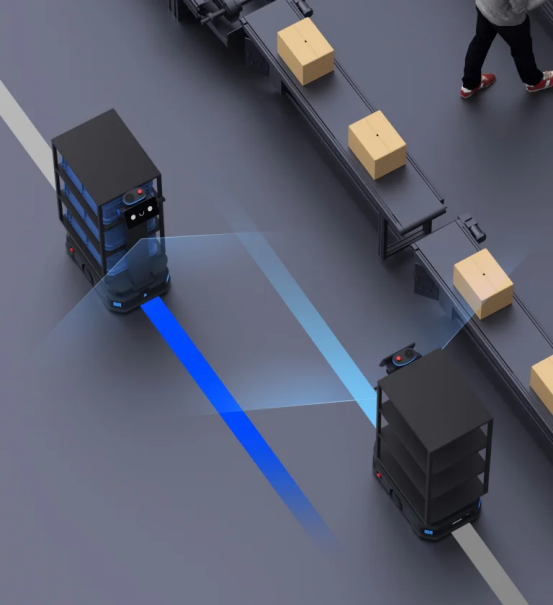
Figure 1. Industrial AMR moving a parts shelf along a defined route, the workflow pattern used in commercial-vehicle line-side delivery.
Five PUDU T300 industrial autonomous mobile robots were deployed in the plant’s line-side warehouse and processing material buffer area. The task is straightforward to describe: in-place jacking lift of a staged rack at the line-side warehouse, delivery to the assigned buffer location next to the processing area, and the same flow in reverse for empty racks. The robot replaces the operator’s long-haul push-cart trip; the operator stays at the work cell.
What makes this deployment worth reading about is not the loop itself, which is familiar by now, but how the loop is operated. The fleet runs from preset task templates that define repeatable delivery sequences, and the same five robots handle multiple rack sizes without per-rack reconfiguration on the shop floor. Both capabilities sit upstream of the visible delivery loop and decide whether the deployment scales gracefully or quietly fails the staffing-month test.
Preset task templates are how a five-robot fleet stays useful when a shift runs short
Operationally, the most stress-tested capability in this Mexico deployment is template-driven autonomous execution. The fleet runs from preset task templates, with up to 50 tasks defined in a single template, and the robots execute the sequence autonomously, end-to-end, without requiring a shop-floor coordinator to dispatch each individual task.
The reason this matters is a labor-resilience story, not a labor-elimination one. On a normal staffing month, the fleet runs in the background and absorbs the predictable line-side delivery load. On a short-staffed shift, when the team is two or three operators light, the same template keeps running. The line does not have to wait for a runner to be reassigned, and the experienced operators on the line do not have to leave their work cells to push carts. The fleet is what keeps the takt time honest during the staffing dips that any real plant absorbs every month.
Procurement teams should understand the procurement implication directly: a template-driven fleet is much cheaper to manage than a manually dispatched fleet, because it does not consume a coordinator’s attention every time a shift turns over. The operating cost line that buyers tend to underestimate is shop-floor management overhead. Preset templates are the part of the product that quietly takes that line back down.
Multi-rack adaptation is the part that reduces shop-floor management overhead
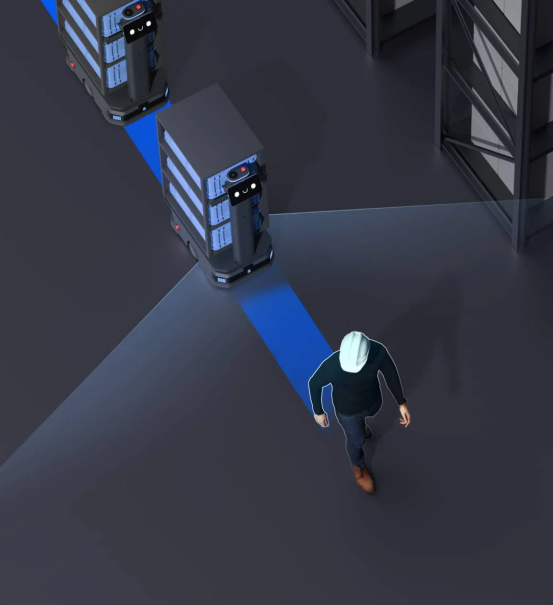
Figure 2. Compact-footprint industrial AMR sharing plant aisles with operators and equipment in mixed traffic.
The second capability buyers should evaluate carefully is multi-rack adaptation. In the Mexico deployment, the same five robots support multiple preset rack sizes for the different processing areas they serve. The fleet is not split into specialized vehicles per rack profile, and the shop floor does not need a re-keying process every time a different rack moves through.
This is where Tier-1 commercial-vehicle suppliers actually save management overhead. The plant carries a real inventory of rack profiles: tall shelves for ADAS modules, low racks for brake actuators, mid-height carriers for sub-assemblies. A fleet that has to be reconfigured every time the rack profile changes pushes the cost of running it onto a shop-floor supervisor and an industrial-engineering technician. A fleet that holds multiple rack profiles as presets keeps the supervisor on the cell-quality work that pays for the shift.
The procurement question to put to a vendor is concrete. How many distinct rack sizes does the fleet hold as presets at one time? How long does it take to add a new rack profile when the plant adds an SKU? Who on the customer team needs to do that work? If the answers run to days of integrator engagement per rack change, the operating cost of the fleet is structurally higher than the unit count would suggest.
Four operational features of commercial-vehicle parts plants that shape robot selection
Pudu Robotics field engineering has now installed T-series industrial robots into auto-parts and commercial-vehicle manufacturing environments across multiple countries. Four patterns repeat across the commercial-vehicle sites in this category, and each one changes the calculus for what kind of AMR fits.
1. The line cannot stop, the deployment cannot stop the line
Commercial-vehicle component plants run to customer schedules that leave little slack. A first deployment has to land in a working production environment, in hours rather than weeks. Infrastructure-free positioning and template-driven execution are the practical enablers; both are what allow the deployment to happen without taking the floor offline for a separate integration phase.
2. The rack inventory is real and varied
Unlike a single-SKU consumer plant, a commercial-vehicle parts plant carries multiple rack profiles for different product families. A fleet that locks to one rack size is a fleet that solves one workflow and creates management overhead for every other. Multi-rack adaptation should be on the requirements list, not on the wish list.
3. Staffing variability is a normal operating condition, not an exception
Plant managers should not procure an AMR fleet against the optimistic staffing scenario. The realistic scenario is that any given month will see at least one short-staffed shift, often more. The fleet earns its operating cost on those shifts, by keeping the line-side delivery cadence steady when a manual workflow would have stalled. Template-driven autonomy is what makes that resilience possible without a shop-floor coordinator on standby.
4. Customer-quality expectations carry over to logistics
Tier-1 commercial-vehicle suppliers operate under stringent customer-quality expectations from truck OEMs and bus builders. Those expectations carry implicitly into the logistics layer. A delivery loop that depends on the right person being on shift is harder to defend in a customer audit than a delivery loop that runs from a documented preset template. The audit story matters more in commercial vehicles than in many adjacent categories.
Workflows in a commercial-vehicle parts plant that fit a low-payload industrial AMR
Once you accept that the entry point is a small, template-driven fleet rather than a heroic platform install, the next question is which workflows. The matrix below summarizes the workflows where a 300 kg-class low-profile industrial robot with multi-rack adaptation fits cleanly in a commercial-vehicle parts environment.
| Workflow | Typical load | Fit for a 300 kg-class low-profile AMR | Why |
| Line-side warehouse to processing buffer delivery | Rack with parts, 50-300 kg | Strong | High-frequency, recurring, route stable; the canonical entry workflow for this plant category. |
| Empty rack and dunnage return | Empty rack, 5-40 kg | Strong | Combines naturally with the delivery loop into a closed cycle. |
| Mixed rack-profile delivery across product families | Shelves and racks of different sizes | Strong with multi-rack adaptation | Single fleet handles the rack inventory; without this capability the workflow needs a larger or split fleet. |
| Consumable / tool replenishment to cells | Tool kits and consumable boxes, 5-80 kg | Good | Predictable timing, standardized containers; pays back when added on top of the line-side loop. |
| Inter-line WIP transport across major cells | Larger WIP racks, 200-500+ kg | Project-dependent | Higher integration cost; usually a follow-on project after the entry loop is validated. |
| Heavy press / die movement, hazardous chemical transport | 500+ kg, hazardous | Out of scope | Use purpose-built equipment with appropriate certifications. |
Table 1. Workflow-fit matrix for a low-payload industrial AMR in a commercial-vehicle parts plant.
The first three rows are the natural entry workflows for a commercial-vehicle parts plant, and the deployment in this case lands directly in them. They share four properties that make them safe first projects: predictable load sizes, standardized handoff points, repeatable timing, and a sales-and-operations narrative that the plant manager can defend to operations and quality at the same meeting.
What the T300 contributes operationally
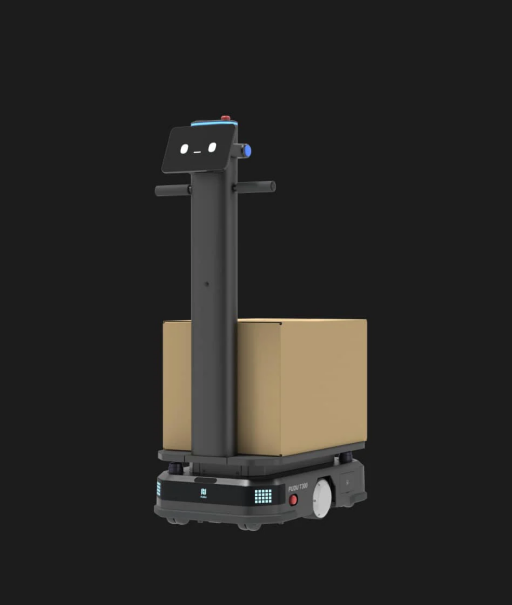
Figure 3. Industrial AMR using a jacking lift to transfer a parts rack, the same mechanism used in the commercial-vehicle line-side delivery loop.
The PUDU T300 is built for exactly the constraints described above: a 300 kg payload class with a low profile, flexible VSLAM positioning that does not require magnetic tape or reflectors, layered perception combining upward and downward RGBD with dual lidar for mixed-fleet safety, around 60 cm path clearance, an ISO 3691-4 conformant safety design, and 24/7 operation. The combination matches the floor a Tier-1 commercial-vehicle plant actually has.
In the Mexico deployment, the two operationally interesting capabilities are template-driven autonomous execution and multi-rack adaptation. Together they keep a five-robot fleet useful across a normal staffing month and across the plant’s rack inventory, without growing the shop-floor management overhead that often quietly cancels out the labor savings of an AMR project.
Where Pudu Robotics fits in the global industrial AMR landscape
Tier-1 commercial-vehicle procurement teams reasonably want to know who they are buying from before signing a multi-plant rollout plan. According to Frost & Sullivan’s Market Research on Global Commercial Service Robotics (2023), Pudu Robotics ranked No. 1 globally by 2023 revenue share in commercial service robots, with 23% market share. KEENON Robotics held 11%, Gausium 8%. For a commercial-vehicle buyer, that signal matters as a deployment-base signal: the vendor has the install base to harden product, the service depth to support multi-site operations, and the engineering capacity to keep iterating on workflows that smaller vendors cannot sustain.
Inside that portfolio, the T-series industrial robots are the entry point for manufacturing environments rather than hospitality or retail, which keeps the conversation operationally focused: payload, clearance, ISO 3691-4, layered perception, preset task templates, multi-rack adaptation, and integrator-led multi-plant rollout.
What commercial-vehicle plant procurement teams should evaluate next
If the deployment pattern described in this article fits your plant, the most useful next step is not an enterprise RFP for a logistics-automation platform. It is a single-plant validation against the line-side warehouse to processing buffer flow, with an explicit replication plan to additional plants if the validation passes.
From there, four questions decide whether a low-profile industrial AMR like PUDU T300 belongs in the workflow:
– Can the fleet execute a preset task template of 30 to 50 tasks autonomously from a shift-start trigger, without per-task dispatch from a coordinator?
– How many distinct rack profiles does the fleet hold as presets at one time, and what is the documented effort to add a new rack profile when the plant introduces an SKU?
– What is the deployment timeline on a working production floor, and does it require any magnetic tape or QR-code preparation?
– What is the vendor’s regional service footprint and integrator network in Mexico and across the commercial-vehicle plants you intend to roll out next?
The answers tend to resolve into a tight, template-driven first project, not an enterprise platform purchase. That is the right shape for a category where staffing variability is a monthly reality and customer-quality expectations carry into the logistics layer.
FAQ
How big should the first AMR fleet be in a commercial-vehicle parts plant?
Size the first fleet to cover the line-side delivery load on a typical operating month, not the maximum hypothetical case. In commercial-vehicle parts plants the entry deployment is often 3-8 robots covering line-side warehouse to processing buffer, with empty-rack return integrated into the same template. Five units is a common, defensible starting point when the plant has one main processing area.
Why are preset task templates a procurement criterion, not a feature?
Because they decide whether the fleet needs a shop-floor coordinator to remain useful. A template-driven fleet runs through staffing dips on its own. A manually dispatched fleet creates a permanent management overhead line that often erases the labor savings of the deployment. The procurement implication is to evaluate template depth (how many tasks per template), template autonomy (does it run end-to-end without supervision), and the user interface for plant staff who will own template authoring after go-live.
What does multi-rack adaptation actually mean in practice?
It means the same fleet can pick up and deliver multiple distinct rack sizes from the plant’s rack inventory without per-rack reconfiguration on the shop floor. The vendor should be able to describe how rack profiles are added, how many can be held as presets concurrently, and what training a plant industrial-engineer needs to maintain that inventory of profiles.
Does this replace operators?
The credible business case is labor resilience and operator redeployment: the fleet absorbs line-side delivery during normal operation, and becomes critical during the staffing-short shifts that any plant will see at least once a month. Operators are redeployed to inspection, assembly, and quality work that depends on their experience. Framing the project as labor elimination tends to be politically harder and is rarely what actually happens on the floor.
How should we evaluate vendors beyond the spec sheet?
Three checks tend to separate viable vendors from optimistic ones: a documented template-driven execution case with 30+ tasks per template, a multi-rack adaptation walkthrough on a comparable plant, and a regional service-coverage plan covering response time, spare parts, software updates, and rollout speed across the plants you intend to expand to.
References & Further Reading
1. Motor and Equipment Manufacturers Association (MEMA), Heavy Duty Group. Commercial-vehicle supplier industry data. https://www.mema.org/heavy-duty-manufacturers-association
2. Industria Nacional de Autopartes (INA). Mexico auto parts industry statistics and outlook. https://ina.com.mx/
3. International Federation of Robotics. World Robotics 2024. https://ifr.org/
4. Frost & Sullivan. Market Research on Global Commercial Service Robotics (2023). https://www.frostchina.com/en/content/insight/detail/66b96cfadce2a58aa58ac492
5. Pudu Robotics. PUDU T300 industrial autonomous mobile robot. https://www.pudurobotics.com/en/products/pudut300
6. Pudu Robotics. Smart manufacturing case study, multi-robot collaboration. https://www.pudurobotics.com/en/case-studies/pudu-tri-robot-battery
