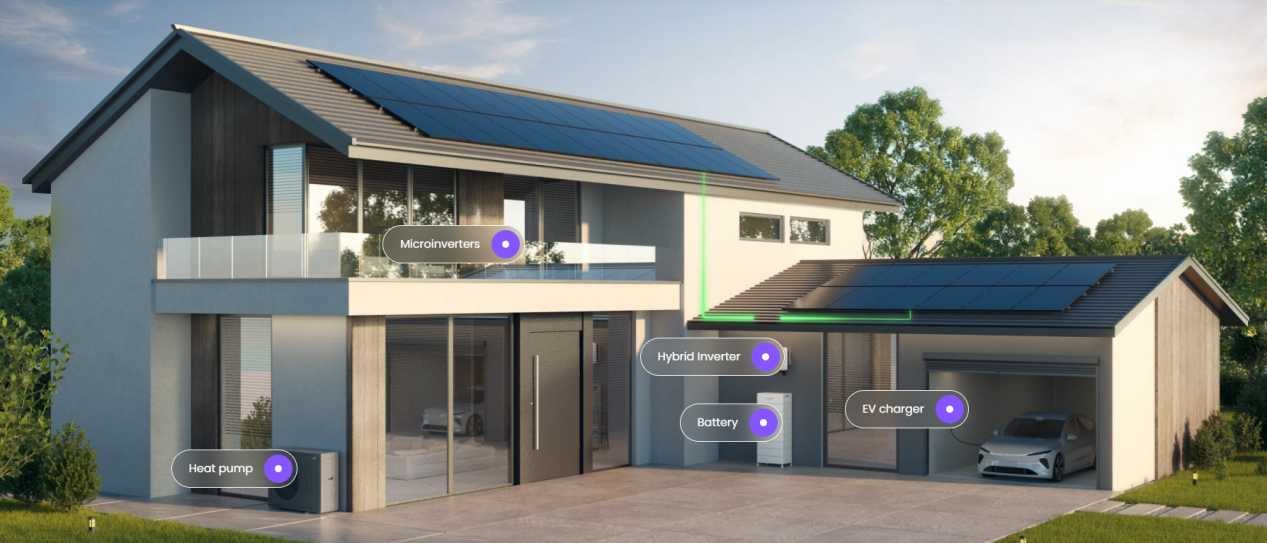
Buying residential storage is often treated as a decision about how many kilowatt-hours a household needs today. That approach can miss the more difficult question: will the system still fit the home after its energy requirements change? Solar generation may increase, electricity consumption may shift, or new loads may appear. A system that looks appropriately sized at installation can become restrictive if its architecture leaves little room for adjustment.
Long-term value therefore needs to be evaluated as a lifecycle question. Rather than focusing on initial capacity or a predicted payback period, homeowners and installers can examine whether the system can expand, operate efficiently, remain properly matched, and provide useful information throughout its service life.
Long-Term Value Starts With What Can Change
Household energy demand is rarely static. A home may initially use storage mainly to shift daytime solar generation into evening consumption. Later, an EV charger, electric heating, or a larger PV array could alter both the amount and timing of electricity demand.
That makes the future operating scenario part of the original storage specification. An installer should identify which changes are reasonably foreseeable and then determine whether the proposed architecture can accommodate them.
The distinction between a large system and a scalable system is important here. A large battery provides more capacity from the beginning. A scalable system, by contrast, provides a defined route for increasing storage as requirements develop. The latter can be more relevant when future demand is uncertain.
Fox ESS offers residential energy systems across multiple markets and product categories, with system configurations adapted to different local conditions and installation requirements. These energy storage cases are useful as reference points, but they should not replace project-specific load and generation analysis.
Expansion Should Be Planned Before the First Battery Is Installed
Scalability has practical meaning only when the expansion route is technically defined. Questions should therefore be asked before commissioning: which battery modules can be added, what configuration limits apply, and which inverter models support the intended arrangement?
Product architecture can make this assessment clearer. Fox ESS offers several high-voltage battery families designed as scalable residential energy storage systems. For example, the published EP6 range is listed from 5.76 to 23.04 kWh, while EP11 is listed from 10.36 to 41.60 kWh. These ranges demonstrate the principle of modular capacity growth, but the correct configuration still depends on the relevant inverter and installation requirements.
Future expansion also has a physical dimension. Available wall or floor space, cable routes, electrical protection, ventilation, and installation access can influence whether additional storage is practical later. A theoretically expandable system may be much less valuable if expansion becomes difficult at the property.
Residential cases should therefore be read for architecture rather than simply for headline capacity. They can show how different battery and inverter combinations have been deployed, helping installers compare possible system pathways rather than copying a nominal size.
Efficiency Depends on the Whole Energy Path
Long-term efficiency cannot be judged from the battery specification alone. Electricity may travel between PV generation, the battery, the inverter, household loads, and the grid through several conversion stages. Each stage can influence the amount of energy ultimately available to the home.
Standby consumption deserves particular attention because it occurs even when the system is not transferring large amounts of energy. In a broader energy storage efficiency assessment, continuous auxiliary consumption from components such as the inverter, battery management system, and communications equipment can accumulate over long periods.
Architecture also matters. High-voltage battery systems can reduce current for a given power level, which can reduce resistive losses in electrical components. Hybrid inverters can coordinate several energy pathways within one system, potentially reducing unnecessary conversion steps.
Consequently, the relevant question is not simply “What is the battery efficiency?” A better question is whether the complete battery–inverter architecture delivers energy efficiently under the operating conditions expected at the property. The published efficiency discussion from Fox ESS also highlights system-level measures such as the System Performance Index rather than relying on a single component specification.
Battery–Inverter Matching Determines Whether Scalability Is Practical
Adding storage is not equivalent to adding another appliance. Battery voltage, inverter operating limits, communication, battery management, and supported configurations all have to remain compatible.
A future expansion plan should therefore identify the complete system combination, not just a preferred battery family. An inverter with insufficient power capability can become a constraint even if additional battery capacity is technically available. Conversely, adding substantial storage to a system without sufficient demand may not improve how effectively the available energy is used.
Fox ESS positions its hybrid inverters and high-voltage batteries as complementary parts of an integrated storage architecture. Its published hybrid-inverter range includes single-phase and three-phase products, with different power ranges and system characteristics.
This is where a lifecycle evaluation becomes more rigorous. The question is not simply whether two components communicate today. It is whether the selected combination leaves a documented and technically feasible route for the household’s expected future configuration.
Operating Data Reveals Whether the System Still Fits the Home
A system can be technically expandable yet poorly matched to how a household actually operates. Monitoring helps reveal that difference.
Daily data can show whether the battery is regularly being charged from available PV, whether stored energy is being used during relevant demand periods, and whether the system frequently reaches operational limits. Over time, these patterns can expose changes in household behaviour that were not visible during the original design stage.
Remote monitoring can also make system management less dependent on occasional physical inspection. The hybrid-inverter portfolio includes models with remote monitoring through an app or web portal, providing a way to observe system operation after commissioning.
Energy storage cases become more useful when viewed through this operational lens. Instead of asking only how much capacity a project installed, installers can consider why the chosen architecture suited its generation, demand, and management requirements. That perspective makes case studies more relevant to long-term system evaluation.
A Scalable System Should Still Make Sense Years Later
The strongest test of long-term value is simple: can the system remain technically appropriate when the household no longer looks exactly as it did on installation day?
A convincing answer requires more than expandable battery capacity. The expansion route must be supported by the system architecture. Efficiency must be considered across the complete energy path. Battery and inverter specifications must remain compatible. Monitoring must provide enough operational visibility to identify changing patterns and potential constraints.
That combination is more meaningful than an isolated capacity figure. It also avoids treating financial assumptions as engineering facts. Return on Investment (ROI) and payback periods depend on electricity prices, tariffs, usage patterns, installation costs, incentives, and future market conditions. These factors should be assessed separately rather than inferred from product specifications alone.
